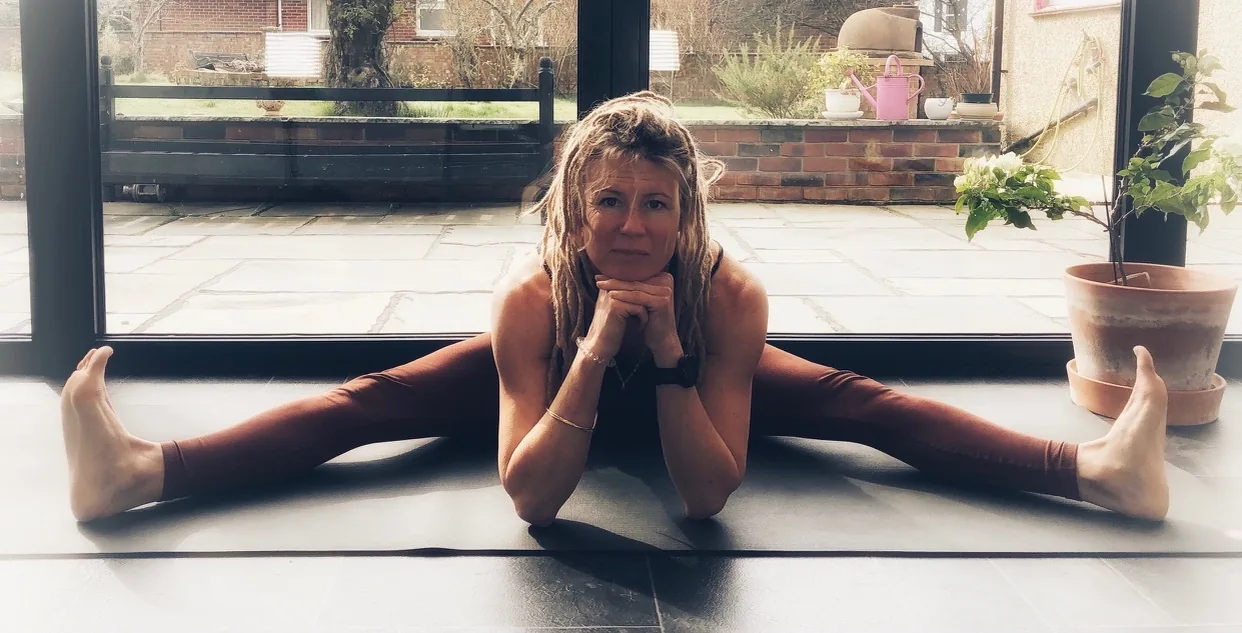
Not everyone lives on the Isle of Wight, and even the people who do have weeks where getting out of the house is the hard part. This is for those weeks — the same teaching, the same voice, on your own floor at whatever hour suits.
It isn't an algorithm feeding you strangers. Emma made this for her own students, for people who've been on retreat with her, and for anyone sent along by a friend who'd rather practise with someone who knows what they're doing than scroll through the endless online alternative.
The practices are catalogued by approach, duration and level, so you can pick what actually fits the day rather than taking whatever comes next.
There are two ways in. Free classes on YouTube, which is the honest place to start — see whether you like how she teaches before spending anything. And the library on Patreon, which is where the depth is: a growing archive you can work through at your own pace for a small monthly amount.

The place to start. Full-length practices, no payment, no sign-up beyond a subscribe if you'd like to know when a new one lands. If you like how Emma teaches here, you'll like the rest.
Where the archive lives. A growing collection of practices you can come back to as often as you like. There's no set price and no minimum — you decide what it's worth, and what you give is what keeps Emma able to make more.
There is no price on the library. You pay what you want — and if that is a pound, you are every bit as welcome as anybody else.
This isn't a marketing device. In the tradition Emma teaches from, the teachings were given freely and supported by dāna: an offering made by those who could, so that the teaching stayed within reach of those who couldn't. The teacher taught. The people who valued it made that possible. Nobody was turned away for not having enough.
So give what the practice is worth to you this month. Change it when your circumstances change. Stop when you need to and come back when you can. Emma would rather you practised.
Every practice is tagged, so you can go at it from whichever direction suits — the time you've got, the level you're working at, or the kind of thing you're in the mood for.
From ten minutes before work to a full ninety when the day allows it. The forty-five and sixty minute practices are the deepest sections of the library.
Most of the library is open to anybody — over a hundred and twenty practices are tagged Yoga for All. There's a substantial intermediate section for when you want more, and a small set written specifically for people starting out.
Asana is only part of it. There's meditation, breathwork and yoga nidra in here too, plus a run of short clinics taking a single thing apart — the sort of question you'd ask after class if there were time.
Some of it is built to be worked through in order. Mindful Mornings is a long run of forty-five minute starts to the day; the Solstice sets are twenty-one days of practice taken together; and the equinox and seasonal series follow the turning of the year, the way Emma's writing does.
Numbers are the practices tagged in each category as at September 2026, and a practice usually carries more than one tag — a forty-five minute Ashtanga session tagged Yoga for All appears under all three. The library keeps growing.
A mat, enough floor to lie down with your arms out, and somewhere to prop a screen where you can see it from the floor. Blocks and a strap are useful but a couple of books and a dressing gown cord have got plenty of people through.
Emma teaches as she always does, which means she'll tell you what to do with your body rather than just naming a pose. If you've practised a bit you'll get more from it, but nobody is going to be left behind at home either.
The best home practice is the one that happens. Ten honest minutes beats an intended ninety that never arrives. The library has both, and there's no merit in the longer one if it's the reason you don't unroll the mat.
That's the one real drawback of practising at home — Emma can't spot what she'd spot in a room. If you're carrying something, email her before you start rather than working around it on your own.
“An alternative to scrolling through endless online content from people you've never met.”
The full library, for whatever you decide it's worth — there is no minimum. Or start with a free class on YouTube and decide afterwards.
The Patreon button opens Emma’s page on Patreon, a separate website. It’s how you support her work, and in return the whole library of practices opens up to you. What is Patreon?
Questions first? Email Emma — she answers personally.
Live feed, pulled straight from @emmaspencergoodier.